
Meet a Flight Medic caring for families around the world
We spent time with one of our flight medics, Vickey, to learn more about life on a Lia's Wings transfer and what it takes to support children and families through some of their most challenging moments.
When families meet Vickey, they are often at one of the most difficult moments of their lives. A child has become seriously ill or injured overseas. Days, weeks or even months of uncertainty may have passed. Parents are exhausted, frightened and far from home, navigating unfamiliar healthcare systems, language barriers and the overwhelming reality that their child needs specialist care. Then Vickey arrives.

As one of Lia's Wings' flight medics, Vickey is often the first person families meet on their journey home. Alongside clinical expertise, her role requires adaptability, communication, problem-solving and the ability to connect with people in crisis.
A medical escort flight might sound straightforward: meet a family overseas and bring them home. The reality is often far more complex. Every journey involves countless moving parts. Flight schedules change, medical circumstances evolve, and new challenges can emerge at any moment. A successful transfer relies on someone who can think quickly, adapt calmly and find solutions under pressure. As Vickey explains, plans rarely stay as plans for long.
"You have to change your plan A to plan B, to plan C, to plan D all the time. You have to be thinking on your feet all the time."
What families see, however, is not the problem-solving happening in the background. They see someone calm, reassuring and focused entirely on helping them get home safely. Vickey compares it to a swan gliding across the water. On the surface, everything appears smooth and effortless. Beneath the surface, there is constant movement, coordination and decision-making to keep everything on track.
That ability to remain calm becomes particularly important when working in unfamiliar environments around the world. One of Vickey's first Lia's Wings transfers took her to Nigeria to support premature twins returning home. Alongside the clinical responsibility of caring for vulnerable babies throughout a long journey, she was also navigating a different healthcare system, culture and way of working.
For Vickey, working internationally requires a careful balance of respect, adaptability and advocacy. She understands that local healthcare professionals know their patients, systems and environments best, while also ensuring she does everything possible to help children return home safely.

"You are going into their country, and you need to respect the way that everyone has a job to do and everyone is an expert in their own job," she explains. "It's for us to negotiate how we can both do our jobs and get the best possible result, which is bringing the babies or the children home."
Whether communicating through Google Translate, working alongside overseas medical teams or adapting to a different way of doing things, the goal remains the same: bringing children home safely.
Supporting children, however, is only part of the role. Throughout our conversation, it became clear that some of Vickey's most impactful work happens with parents.
"The patient and the parents have been through the most traumatic experience they're probably ever going to have in their life," she says.
One recent transfer involved a baby receiving treatment overseas. Medically, the child was doing well, but Vickey recognised that another family member needed support.
"I realised the dad probably needed more support than the baby. As long as the baby is fine and medically safe, let's look after Dad because Dad also needs this."
It is a simple observation, but one that captures the way Vickey approaches every transfer. She looks beyond the immediate clinical need to understand what each family member is experiencing and where support is needed most.
For her, no case is ever about a single patient.
"It comes as a bubble," she says. "It's not just one person, it's the whole family." That philosophy was evident during another recent transfer. While a child was stable and receiving treatment, Vickey recognised that their mother desperately needed a break from the relentless cycle of hospitals and hotel rooms.
"The day after I arrived, I saw that the mum just needed a break. She just needed to get away from the hospital and have some adult conversation, so I took her shopping."
The pair spent several hours together exploring local markets, shopping and stopping for coffee. "For her, that was amazing," Vickey recalls. "She was smiling, and we were just having a bit of a laugh."
It was a small gesture, but one that offered a few precious hours of normality during an otherwise overwhelming experience.
Moments like these do not appear in medical records. Yet they are often the moments families remember most.
Perhaps nowhere was this more evident than in her relationship with Mayla.
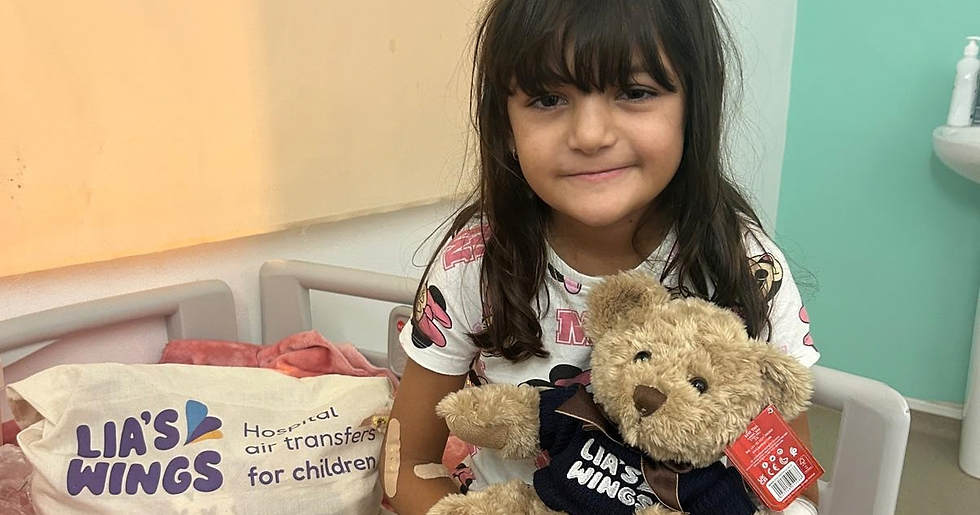
When Vickey first met her, Mayla had become quite fearful of healthcare professionals after spending an extended period in hospital overseas. Every new medical face represented another procedure, another needle and another difficult experience. Building trust would take time.
At first, Mayla avoided eye contact and wanted little interaction. Gradually, through patience, conversation and simply being present, a connection began to form. During one outing, Mayla painted Vickey's nails. It was a small moment, but a significant step.
By the time they boarded the flight home, the transformation was remarkable.
"I sat next to her on the plane on the way back, and it literally brought a tear to my eye. She fell asleep on my shoulder."
That moment speaks to the unique role Lia's Wings medics play. They are not only responsible for a child's clinical care and accompanying the child home, but for helping frightened children and exhausted families feel safe and understood.
As Vickey puts it: "You can walk away with a medical report, but you don't get any of this. All the bits that make the difference are all of these parts. The human side of it.
A message from Vickey
Having supported families through some of the most difficult moments of their lives, Vickey is clear about the difference Lia's Wings supporters make.
"Sometimes families think it's never ever going to end, and it's never going to get any better. When we turn up, we are the tiniest glimmer of light and hope that their ordeal and their nightmare are coming to an end."
Thanks to your support, experienced professionals like Vickey can bring together clinical expertise, adaptability, compassion and humanity, helping children and families navigate one of the most challenging journeys they will ever face and bringing them safely home.


